

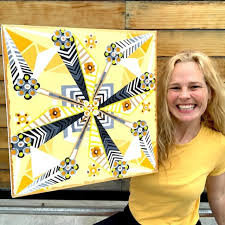
Kibbi Linga is a self-taught artist whose work transcends creativity. Alongside her siblings, she was subjected to extreme abuse, including cannibalism and incest.
She channels her lived experiences with PTSD into powerful visual narratives using painting as a form of therapy. Each brushstroke is an act of defiance, a step toward healing, and an invitation for others to witness the strength it takes to survive.
Los Angeles-based psychedelic abstract artist Kibbi Linga has captivated audiences not only with her artwork but also with her courageous journey of survival and healing.
Her deeply personal story has resonated with many, highlighting the transformative power of creativity in overcoming adversity.
Her striking, surreal compositions serve as both an escape and a confrontation of her past.
Kibbi’s work channels the pain of surviving Satanic ritual abuse (SRA) and childhood trauma into vivid, dreamlike visuals that invite viewers into her emotional and psychological landscape.
Through abstraction, she explores themes of dissociation, rebirth, and spiritual awakening, offering a raw yet hopeful perspective on the recovery process.
Beyond her art, Kibbi has emerged as a powerful advocate, sharing her story through interviews, podcasts, and public discussions.
She launched her podcast, “She Got Away,” which delves into critical topics like ritual abuse, dissociation, coping mechanisms, and healing from extreme trauma.
Kibbi Linga Parents: A Dark Story of Abuse and Control
Kibbi Linga’s childhood was one of unimaginable horror, shaped by the cruelty of her parents, a mother who ruled as a high priestess in a Satanic cult and a father who obeyed her every command.
Her story, shared gradually on social media, reveals a family dynamic built on fear, manipulation, and extreme abuse.
Her mother was the dominant force in the household, serving as the high priestess of a cult that subjected Kibbi and her siblings to unspeakable rituals.
In an Instagram reel, Kibbi hinted at her mother’s terrifying influence, stating, “She was the high priestess, but I just don’t feel safe enough yet [to show her picture].”
The abuse she endured was systematic and sadistic, a forced cannibalism, incest, confinement in cages, and psychological torment. Her mother’s control was so absolute that she describes her as highly intelligent and methodical, evading legal consequences.
When asked why her mother was never imprisoned, Kibbi replied, “Only irrational serial unnallivers get caught. Everything was smart, organized, and the intelligence of planning was top notch.“
In stark contrast, Kibbi’s father was passive and submissive, blindly following her mother’s orders. She described him as a doormat who never resisted her mother’s demands.
His compliance allowed the abuse to continue unchecked. He died when Kibbi was just nine years old, leaving her and her siblings trapped under their mother’s rule.
The trauma Kibbi suffered led to her developing Dissociative Identity Disorder (DID), a coping mechanism to survive the relentless abuse.
She has bravely shared fragments of her story on TikTok and Instagram, including updates on her siblings, who endured similar horrors.
Her journey toward healing is ongoing, and she shares her truth at her own pace, guided by her faith. While she has yet to expose her mother fully, she has promised a “mom drop” when the time is right.
Kibbi’s Story of Trauma and Art: Healing Through Creativity
Growing up in an oppressive environment, Kibbi dreamed of freedom and self-expression. Despite the constraints of her upbringing, she nurtured a deep desire to break free and pursue a life filled with creativity.
Determined to reclaim her autonomy, she escaped her past and embarked on a journey of healing through art.
Kibbi is a self-taught artist who began painting in May 2019 as a therapeutic outlet for her PTSD. What started as a coping mechanism soon evolved into a powerful form of self-expression.
She describes her art as a way to express feelings and truth majestically and colorfully, transforming pain into beauty. Her vibrant, abstract works reflect her emotional journey, each piece a testament to resilience and renewal.
Kibbi shares her art with the world through her website, kibbilinga.com, where she displays and sells her paintings. Her bold use of color and fluid forms invites viewers into her inner world, one where trauma is not just endured but alchemized into something transcendent.
Beyond painting, she explores other creative avenues, including video editing and photography, further expanding her artistic voice.
Kibbi also uses her platform to advocate for mental health awareness and survivors of ritual abuse. By openly sharing her healing process, she inspires others to embrace self-expression as a path to recovery.
While she keeps details of her personal life private, her social media presence serves as a space for connection, encouragement, and empowerment.
